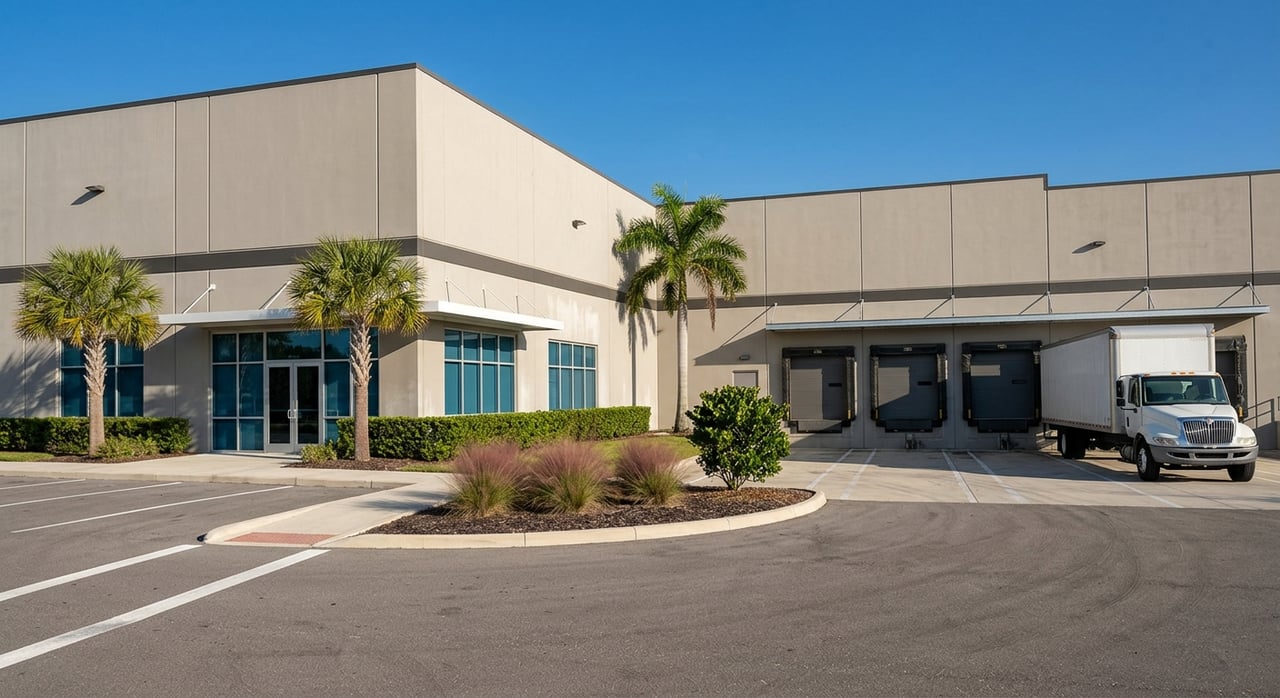
If you are looking at industrial real estate in Tampa, old site selection rules are not enough anymore. The market is no longer just about finding warehouse space near customers. Today, Tampa’s logistics boom is pushing users and investors to think harder about port access, interstate reliability, labor reach, and the difference between infill space and fringe development. Let’s dive in.
Tampa’s logistics edge is getting stronger
Tampa keeps attracting logistics users because it combines several important advantages in one market. Port Tampa Bay offers direct truck access to the Selmon Expressway, which connects into I-4 and I-75, plus rail access through CSX. The port also describes itself as the closest port to the I-4 Corridor, a distribution spine that stretches from Tampa to Orlando with more than 550 million square feet of distribution centers.
That network matters more now because the port is still expanding. Port Tampa Bay reported a new weekly Maersk Cartagena service beginning in early 2025, fiscal 2025 cargo volume of 32 million tons and nearly 263,000 TEUs, and six post-Panamax cranes expected by the end of 2026. It also said the harbor-deepening project is moving toward a 47-foot channel, which supports larger-scale cargo activity over time.
For you, that changes the underwriting conversation. A site near the right freight network can now carry more long-term value than a cheaper site with weaker access. In Tampa, logistics users are increasingly choosing locations based on how well they connect to the port, I-4, I-75, and Central Florida distribution routes.
I-4 is more than a highway
In Tampa industrial real estate, map distance tells only part of the story. Travel time and corridor reliability now play a larger role in how companies screen locations.
FDOT’s Tampa Bay Next program describes I-4 as the gateway into and out of Tampa Bay and plans to widen about 17 miles from I-75 to the Hillsborough and Polk County line with buffer-separated express lanes in each direction. That is important because the east-west corridor links Tampa with Polk County, Orlando, and broader Central Florida distribution demand.
This means site selection is shifting from “How close is this building?” to “How dependable is this route?” If your operation depends on truck turns, port drayage, or next-day regional delivery, reliable interstate access can matter as much as the building itself.
Tampa is not one uniform industrial market
One of the biggest mistakes in Tampa site selection is treating the market like one blended average. The headline stats are useful, but they do not tell the whole story.
According to CBRE’s Q1 2026 Tampa industrial figures, the market covered 165.64 million square feet across Hillsborough, Pinellas, and Pasco counties, with 7.5% vacancy, 9.9% availability, and an average direct asking rent of $10.95 per square foot NNN. CBRE also noted that the market is digesting recent supply rather than facing a demand collapse.
The more useful insight is how sharply performance changes by size and location. Buildings under 100,000 square feet had just 3.5% vacancy and a $12.23 direct asking rate, while buildings between 500,000 and 749,999 square feet showed 18.1% vacancy and a $7.06 asking rate. In plain terms, smaller infill space remains tight and expensive, while larger-format space in outer areas has more availability and often lower rates.
That split has real consequences. If you need a smaller, well-located industrial facility in Hillsborough County, you may be competing for a constrained pool. If you need scale and can operate farther from the urban core, the pricing and options may look very different.
Infill versus fringe is now a key choice
Tampa’s industrial market is increasingly a story of two strategies. One strategy focuses on infill access. The other focuses on land, scale, and future expansion.
East Tampa stays important
East Tampa remains one of the region’s core infill logistics submarkets. CBRE reported 53.59 million square feet of inventory there, 5.1% vacancy, $11.54 per square foot in direct asking rent, and 0.55 million square feet under construction in Q1 2026.
That profile helps explain why East Tampa keeps showing up in site searches. It offers meaningful scale, relatively tight vacancy, and strong access into the larger freight network. Even when new vacancy appears, it tends to draw attention because infill options remain limited.
Airport and Westshore command access premiums
The Airport submarket is another high-access option, but usually at a premium. CBRE showed 6.6% vacancy and a $13.52 direct asking rate there in Q1 2026.
Westshore was even tighter, with 1.6% vacancy, though it is a smaller industrial pocket rather than a bulk-distribution corridor. For occupiers, these areas can make sense when central access and service reach are worth paying for.
Plant City and Pasco support scale
If your priority is larger sites, more land, or build-to-suit potential, outer areas are playing a bigger role. Plant City posted 12.7% vacancy, 311,000 square feet of quarterly absorption, and a $7.82 asking rate. Pasco County showed 16.4% vacancy, 1.90 million square feet under construction, and an $11.32 asking rate.
Pasco also accounted for about 42% of active construction in the CBRE report, including projects tied to Amazon, MiTek, and Bauducco Foods. That reinforces a broader shift: Tampa’s logistics growth is not just about speculative warehouse space. It is also being shaped by build-to-suit, owner-user, and network optimization decisions that favor scalable land and highway access.
Labor and population now influence site scoring
Good industrial site selection is not only about truck routes. It is also about whether you can staff the operation and serve a growing customer base.
The Bureau of Labor Statistics reports that the Tampa-St. Petersburg-Clearwater metro has a civilian labor force of about 1.71 million, with about 280.9 thousand jobs in trade, transportation, and utilities and about 73.4 thousand in manufacturing. Those figures help explain why distribution and light industrial users continue to target the metro.
Population growth adds another layer. The U.S. Census Bureau said Tampa-St. Petersburg-Clearwater added 51,622 residents from 2022 to 2023, one of the largest numeric gains in the country. A growing metro can support both labor availability and local consumption demand, which matters for same-day and next-day delivery models.
For you, this means a strong site is not just well located on a map. It should also sit within a practical labor shed and support your customer delivery pattern.
Building specs matter more than many expect
As Tampa matures as a logistics market, users are getting more selective about the product itself. Newer buildings with modern specifications often stand apart from older options, even when they appear similar at first glance.
CBRE defines Class A industrial in Tampa as buildings built after 2000 with 32-foot-or-greater clear height and ESFR sprinklers. That definition gives you a simple benchmark for the kind of product that tends to attract larger and more demanding users.
If you are comparing sites, it helps to look beyond the address and lease rate. Clear height, fire protection, truck circulation, and the ability to support efficient operations can make a major difference in long-term occupancy costs and business performance.
Tampa compares well, but not cheaply
Tampa still looks competitive when compared with other major Florida industrial markets. But that does not mean you can afford to be casual about product choice.
In Q1 2026, Tampa’s 7.5% vacancy was tighter than Orlando’s 10.1% and Jacksonville’s 11.3%, according to CBRE’s market comparison. Tampa’s average asking rent of $10.95 per square foot was also above Orlando’s $10.01.
That combination tells an important story. Tampa is not the loosest market, and it is not a bargain market either. If you are choosing between Florida locations, Tampa can offer a strong logistics platform, but site selection still needs to be disciplined because rents, building quality, and location efficiency vary widely.
What smart site selection looks like now
If you are evaluating industrial sites in Tampa today, the best process usually starts with operational needs rather than listings. A site may look attractive on paper but fail if it misses one or two key logistics criteria.
Here are the factors that matter most in the current market:
- Freight network access to Port Tampa Bay, I-4, I-75, and the Selmon Expressway
- Travel-time reliability instead of simple mileage alone
- Labor catchment and access to the broader Tampa Bay workforce
- Building size fit based on whether you need small infill space or bulk distribution capacity
- Modern specifications such as clear height and ESFR sprinklers
- Expansion potential if your operation may scale over time
- Submarket strategy based on whether you value central access, lower occupancy cost, or larger land positions
In many cases, the winning site is not the cheapest one. It is the one that lowers friction across transportation, labor, and operations.
Why this shift matters for buyers and tenants
Tampa’s logistics boom is changing industrial real estate from a simple location search into a more technical decision. Buyers, tenants, and investors now need to weigh network value, building functionality, and submarket fit much more carefully than before.
That is especially true in a market where small infill space remains tight, outer submarkets are absorbing new construction differently, and port and interstate improvements continue to reshape demand patterns. The right property can support better delivery performance, stronger tenant demand, and more durable value over time.
If you are thinking about an acquisition, lease, disposition, or industrial site selection strategy in Tampa Bay or Central Florida, working with a local advisor who understands both the data and the on-the-ground submarket differences can save time and reduce risk. You can connect with Alan J. Kronenberg for high-touch, locally grounded commercial real estate guidance.
FAQs
Why is Tampa attracting more logistics users?
- Tampa combines port access, direct interstate connections, rail connectivity, and a growing labor and consumer base, which makes it attractive for distribution and light industrial operations.
How is industrial site selection changing in Tampa?
- Site selection is shifting toward port and interstate access, travel-time reliability, labor reach, modern building specifications, and the tradeoff between infill convenience and fringe scalability.
What parts of Tampa are strongest for infill industrial space?
- East Tampa, Airport, and Westshore remain key high-access submarkets, with tighter vacancy and, in many cases, higher asking rents than outer areas.
Why are Plant City and Pasco getting more industrial attention?
- These areas offer more room for larger projects, build-to-suit development, and highway-oriented logistics strategies, which appeal to users that need scale and flexibility.
How does Tampa compare with Orlando and Jacksonville for industrial real estate?
- Tampa had lower vacancy than both Orlando and Jacksonville in Q1 2026, but its asking rents were not low enough to ignore differences in location, building quality, and operating efficiency.
What building features matter most in Tampa industrial properties?
- Modern Class A specifications such as 32-foot-or-greater clear height and ESFR sprinklers are important markers for buildings that can compete for today’s larger and more demanding logistics users.