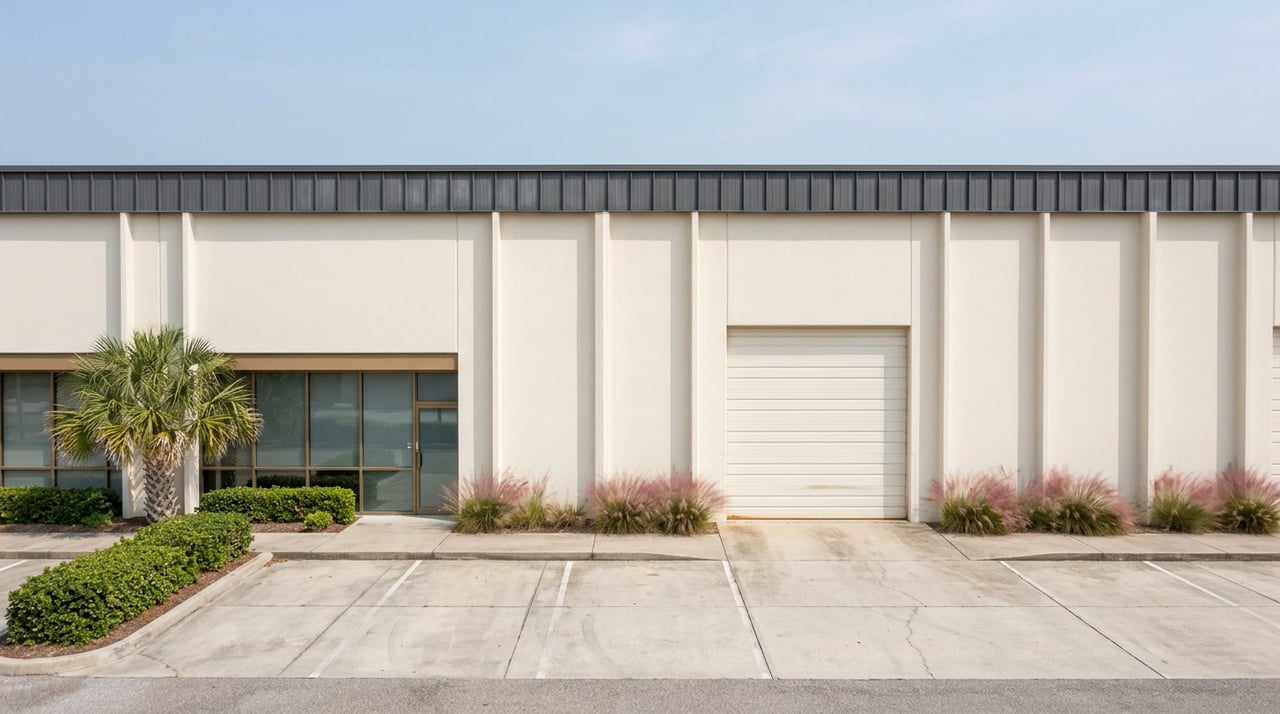
A buyer under contract on a 6,000-square-foot flex building on a side street off North Lois Avenue did what any careful buyer does before closing: pulled a market report. The number that stopped her was industrial vacancy. Tampa's rate had climbed to 8.1% in the second quarter of 2026, according to Matthews' latest tally, with net absorption running negative 872,000 square feet for the quarter. That is not a small move. It is enough to make anyone second-guess a purchase.
Here is the problem with that instinct. The vacancy that's climbing and the building she's buying are barely the same market. Tampa's industrial sector isn't one number moving in one direction. It's two very different segments, big speculative warehouses in the outer counties and small, functional buildings in older, land-constrained pockets close to the urban core, and right now those two segments are telling opposite stories. Drew Park sits squarely in the second category. Understanding why matters more than the headline number ever will.
The Number That's Actually Climbing
Every major brokerage tracks Tampa industrial slightly differently, which is itself a clue worth paying attention to. Matthews put first-quarter 2026 vacancy at 7.3%. CBRE had it at 7.5% for the same quarter. Cushman & Wakefield's second-quarter 2026 read held at 7.4%, flat from the prior quarter but up 30 basis points year over year. Newmark's first-quarter figure ran hotter still, 8.7%, up 93 basis points annually. Matthews' most recent update pushes the number to 8.1% with negative absorption of 872,000 square feet in the second quarter alone.
Even the direction of the trend isn't unanimous. Avison Young's second-quarter 2026 report describes net absorption as staying positive, with leasing surpassing 2.9 million square feet and sales volume topping $210 million, nearly double the prior quarter. Matthews, covering the same quarter, reports absorption went negative by 872,000 square feet. That's not sloppy research on either firm's part. It's a sign that "Tampa's industrial market" is really several markets stitched into one headline, and which buildings a given report counts changes the answer you get.
What every source agrees on is where the softness is concentrated. Cushman & Wakefield's report points to the Lakeland submarket for the bulk of leasing volume. Matthews flags Pasco County as the destination for the largest new construction. CBRE is blunter: new supply and rising vacancy are landing almost entirely in larger-format buildings and outlying submarkets, while infill areas and buildings under 100,000 square feet remain the most supply-constrained part of the market.
That distinction is the whole story.
| Outlying big-box submarkets (Pasco, Lakeland corridor) | Core infill / small-bay submarkets | |
|---|---|---|
| Vacancy trend, 2026 | Rising, some pockets above 10% | Tightest segment in the metro |
| Rent behavior | Headline rents holding near $9.63 to $12.86/SF, but effective rents compressing on larger spaces | Minimal compression, limited concessions even under 5,000 SF |
| Concessions | Free rent and TI packages increasingly common on new deliveries | Scarce, the economics of a small unit don't support months of free rent |
| Construction pipeline | Concentrated here, much of it speculative | Land-constrained, little new supply coming |
Why the Split Runs Through Drew Park's Zip Code, Not Around It
Drew Park isn't a bystander to this split. It's a case study in it. The City of Tampa's own description of the neighborhood calls it one of the few remaining areas in the city with affordable industrial land and space, close enough to Tampa International Airport, Hillsborough Community College, and downtown that it functions as true infill, not overflow.
That positioning shows up in occupier behavior, not just zoning maps. Electric Supply recently completed a 35,000-square-foot expansion within Drew Park. In a submarket with genuinely constrained land, that kind of established-user investment is exactly the sort of signal that doesn't show up in a quarterly vacancy report but tells you more about real demand than the headline number does.
This is the piece worth internalizing if you're comparing Drew Park to a big-box option 30 minutes up I-4: the citywide vacancy figure you're reading is being pulled upward almost entirely by buildings and submarkets you're not actually competing against. If you're underwriting a small-bay purchase in Drew Park, comping it against Lakeland's spec warehouse glut tells you very little about your own building's leasing risk. For a deeper look at how Drew Park's building stock and zoning fit light industrial and flex users specifically, our breakdown of why Drew Park works for these tenants walks through the mechanics in more detail.
The Public Money That Doesn't Show Up in a Vacancy Report
Vacancy rates measure occupied space. They don't measure capital commitment, and Drew Park has more of that right now than the headline numbers would suggest.
The city has already completed a $15.9 million infrastructure and streetscape project along Lois Avenue, described by Tampa's own economic development office as having transformed the function and appearance of the corridor's main gateway through the neighborhood. That's not a pending line item. It's finished work, the kind of durable public investment that tends to support long-term corridor value regardless of what a quarterly CoStar snapshot says about metro-wide big-box absorption.
The Drew Park Community Redevelopment Agency also reallocated $8,194,825 within its own fund for the current fiscal year, according to city council documentation, meaning there is meaningful capital still committed to this specific district's redevelopment pipeline. That kind of dry powder at the CRA level is a better forward indicator for a small submarket like Drew Park than a citywide vacancy average that's mostly describing buildings 30 miles away.
A Financing Lever That's Live Right Now
If the market-level argument doesn't move you, the financing calendar might. Tampa's CRA opened applications for two new commercial grant tiers on September 1, 2026, running through November 1, 2026, covering all eight of the city's redevelopment districts including Drew Park. The Commercial Special Projects Grant provides matching funds up to $999,999. The Commercial Development Grant goes further, matching $1 million or more for transformational property improvements. Both require a pre-application meeting with the city's Economic Development or Project Management divisions before a formal application is accepted, so the clock on this window is shorter than the two-month deadline suggests once you build in that step.
These sit alongside the CRA's longer-running Commercial Exterior Grant program, which has already put real dollars into Drew Park buildings. One property at 4011 W Cayuga St, an existing auto repair shop, received a $50,000 façade grant toward a total project investment of $115,668, with the work completed in November 2023. The owner has since credited the matching structure with turning ordinary commercial buildings into space that draws stronger tenants. That's the kind of comp worth pulling into your own underwriting: a grant that covers roughly 43% of a modest exterior renovation changes the math on a value-add purchase in a way that no vacancy statistic ever will.
What This Changes for Underwriting a Deal in Drew Park Right Now
- Comp against infill and small-bay data, not the citywide blended average. CBRE's own breakdown separates buildings under 100,000 square feet from the big-box product driving the headline number. Ask your broker or appraiser which building set any comp is actually drawn from.
- Treat concessions as a signal, not a given. If a small-bay landlord in Drew Park is offering months of free rent, that's unusual enough for the segment to warrant a direct question about why.
- Check the CRA grant calendar before finalizing a renovation budget. With the Special Projects and Development grant window open through November 1, 2026, and a mandatory pre-application meeting ahead of that, a buyer closing this fall has a real, dated reason to move the financing conversation up rather than treat it as a someday item. Our overview of commercial financing and funding options covers how grant matches typically interact with a conventional acquisition loan.
- Watch public capital, not just private leasing data. A completed $15.9 million streetscape project and an $8.19 million CRA fund reallocation are both stronger long-term signals for this specific corridor than a metro vacancy rate weighted by warehouses you're not competing with.
A Few Direct Questions
Does the citywide industrial vacancy number affect my appraisal in Drew Park? It can influence broad market commentary in an appraisal report, but a competent appraiser should be pulling comps from Drew Park and similar infill, small-bay submarkets rather than blending in big-box product from Pasco or Lakeland. If a report leans heavily on the metro-wide figure without that distinction, it's worth asking why.
Can a buyer apply for the CRA's commercial grants, or only an existing business owner? The programs are described as open to eligible property owners and businesses within the CRA districts. A buyer who will hold the property and use or lease the space would typically fall under that eligibility, but the required pre-application meeting is the place to confirm specifics before you build a grant into your project budget.
The number everyone's citing this quarter describes a market that's mostly somewhere else. If you're looking at a small industrial or flex building in Drew Park, the more useful conversation is about what's actually happening on that block, not what's happening 30 miles up the interstate. That's the kind of read Alan J. Kronenberg works through with clients on every deal, building by building rather than headline by headline. If you're evaluating a purchase, lease, or renovation in Drew Park, let's connect and look at the numbers that actually apply to your building.
This article is general information, not legal, tax or financial advice. Consult a qualified professional about your situation.