Two vacancy prints are circulating on Tampa industrial right now. Newmark's Q1 2026 report puts overall industrial asking rents at a record $9.14/SF against a vacancy rate of 8.7%, up 93 basis points year over year. WareCRE's segment work, using the same quarter, pegs Tampa small-bay at roughly 4.5% vacancy and $10.50+/SF NNN, calling it Florida's tightest small-bay market. Both are correct. They are describing different buildings.
If you are underwriting a Drew Park deal off the wrong one, the whole model is wrong.
The number that actually applies to a 2,500 SF bay
The gap between the two prints is not a rounding issue. It is a supply story. Vacancy likely peaks in mid-2026 as the remaining pipeline delivers, then begins tightening into 2027 as new starts dry up. Tampa's average asking rent reflects a market that is repricing, not collapsing. The 3.4% annual increase is modest compared to 2022's surge, but rents haven't turned negative despite rising vacancy. Landlords are holding firm on face rates while offering more concessions like free rent and TI allowances on larger spaces. For small-bay tenants leasing under 10,000 SF, concessions remain scarce.
The pipeline that is pushing the metro number up is almost entirely big-box speculative product. Newmark's 4.8 MSF under construction pipeline is only 29.3% preleased, and the newly delivered vacancy sits in submarkets built for regional distribution, not for a two-truck contractor with a parts counter. Drew Park was mostly platted before those buildings were architecturally possible.
| Metric (Q1 2026) | Tampa Metro Headline | Tampa Small-Bay Segment |
|---|---|---|
| Vacancy | ~7.1% to 8.7% depending on source | ~4.5% |
| Asking rent | $9.14 to $12.69/SF | $10.50 to $15/SF NNN |
| Concessions | Free rent, TI on 20,000+ SF | Effectively none under 10,000 SF |
| Construction share of stock | ~4.8 MSF, 29.3% preleased | Structurally under-built |
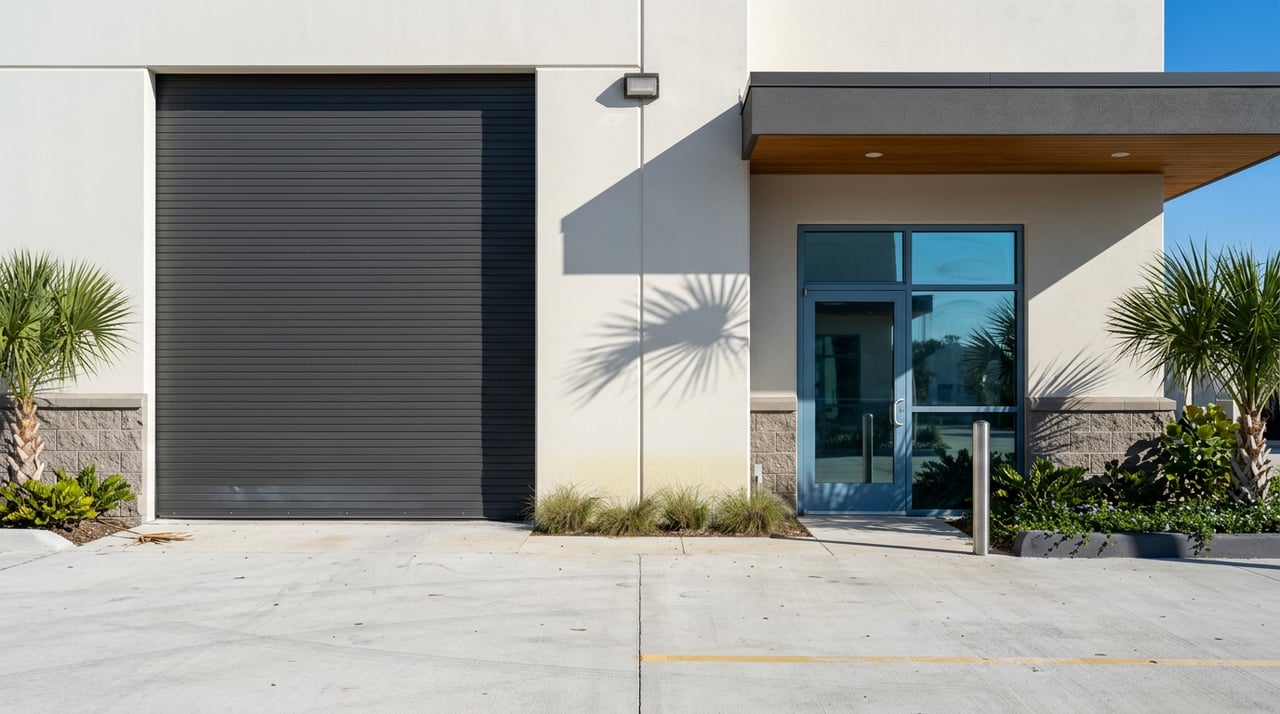
A Drew Park multi-tenant like the Drew Park Industrial Warehouse at 5010 N Coolidge Ave, which recently changed hands and is being repositioned with fresh paint, updated restrooms, LED lighting and epoxy floor coating, is quoting $14.00/SF starting rent with an estimated $5.01/SF CAM on 1,650 to 2,500 SF suites, roughly $2,600 to $3,960 per month all-in before sales tax. That is the small-bay column, not the headline column. Model to the wrong one and the going-in cap rate you present to a seller is a fantasy.
Why the concession gap doesn't close
There is a temptation to assume that if metro vacancy is rising, small-bay landlords will eventually blink. The unit economics say they will not.
- A 2,500 SF bay renting at $14 base plus $5 CAM produces about $47,500 in annual gross revenue. One month of free rent costs the owner roughly $2,900. On a 25,000 SF big-box lease at $8 NNN, one month of free rent costs the owner about $16,600, and the tenant is worth writing the check for.
- Small-bay demand is regenerative rather than cyclical. Tampa Bay continues to add roughly 150 to 170 new residents per day, a migration engine that feeds industrial demand through multiple channels including ecommerce fulfillment, last-mile delivery, food production, and the contractors and tradespeople who build and maintain the housing.
- New small-bay supply is not on the way in any meaningful volume. National tracking puts only 0.3% of total industrial stock under construction in the small bay space, and even if that doubles it is still extremely low.
The tenant leverage that headlines describe is real, but it lives on the other side of Hillsborough County. In Plant City and Lakeland, several spec projects delivered in 2025 and 2026 pushed submarket vacancy above 10%, rents are more competitive at $10 to $12/SF, and tenants have leverage particularly on spaces above 20,000 SF where landlords are competing to fill newly delivered product. A Drew Park HVAC contractor cannot use that leverage. The building he needs is not being built.
What Drew Park has that the broader small-bay market doesn't
The reason Drew Park deserves a separate underwriting column from Pinellas or East Tampa small-bay is the reinvestment layer sitting underneath the parcels.
The neighborhood sits inside a roughly 651-acre Drew Park Community Redevelopment Area, bounded by Tampa Bay Boulevard, North Dale Mabry Highway, and Hillsborough Avenue. The CRA has been steadily moving from planning to construction. The city's own program page states that Electric Supply recently completed a 35,000-square-foot expansion and major infrastructure and streetscape improvements are underway on Lois Avenue, keeping redevelopment momentum moving forward. The Opportunity Zone summary further notes that the $15.9 million Lois Avenue infrastructure and streetscape project has transformed the function and appearance of the major gateway through Drew Park.
The next phase is already out to bid. The Drew Park CRA District right-of-way work along Lois and Grady Avenues from W. Crest Ave to W. Dr. Martin Luther King Jr. Blvd. was posted as project 25-C-00019 with the city's Contract Administration department. This is the reason to distinguish a Grady Avenue bay from an anonymous Hillsborough County flex box. The comparable rents may look similar today. The comparables in 36 months will not.
Airside D is a demand signal, not a construction nuisance
Drew Park's western edge borders Tampa International's fence line. That is usually treated as a locational tag. Right now it is a construction schedule.
TPA has entered the vertical phase of its $1.52 billion Airside D project, the centerpiece of the final phase of Tampa International Airport's long-term master plan, which when it opens in 2029 will add a 600,000-square-foot terminal with 16 gates for domestic and international flights, helping the airport expand from about 25 million passengers each year to an anticipated 35 million annually by 2037. The construction team is explicit about the sequence:
2026 was foundations and steel. 2027 is going to be interiors, glass, roof and then 2028 is a lot of commission and turned things on, getting it ready for that flight in 2029.
Peak staffing is not trivial. Hensel Phelps' general superintendent expects the site to average around 200 folks a day right now, ultimately ramping up to 800 to 1,000 folks through 24-hour shifts to bring all these 600,000 square feet together. Middlesex Corporation is already working overnight to install the bridge superstructure between the new Airside D shuttle station in the Main Terminal and the construction site, with the first steel girders for the future guideway and concrete girders for the walkway lifted onto support piers spanning the George J. Bean Parkway.
For a Drew Park small-bay investor, the read is not about the terminal itself. It is about which types of tenants absorb space in the next 36 months. Airside D pulls in mechanical, electrical, life-safety, low-voltage, fixture fabrication, food-and-beverage buildout, and last-mile logistics subcontractors who need staging within ten minutes of the fence line. After 2029, TPA's throughput jumps by roughly 40% of current volume, and the ground-side vendors, cargo consolidators, and aviation-services operators that support that throughput need physical space in exactly the parcel geography Drew Park offers.
There is one live watch-item that should sit in every underwriting memo. Local reporting notes that a proposed Tampa Bay Rays stadium and mixed-use development at the nearby Hillsborough Community College Dale Mabry campus has Drew Park residents seeking answers on redevelopment, affordability, and how community redevelopment dollars would be used, and a major nearby redevelopment proposal could reshape the area, so buyers should track the outcome and any parcel-level impact. Treat it as optionality, not a base-case assumption.
Underwriting checklist for a Drew Park bay in H2 2026
A tighter framework than the metro model:
- Anchor the vacancy assumption to the small-bay segment, not the headline. If you are modeling to 8.7%, you are pricing in tenant leverage that does not exist on Coolidge, Anderson, or Grady.
- Hold face rate. Model concessions at zero for suites under 10,000 SF, and stress-test one month of free rent only in the renewal year.
- Reconcile CAM. A 2,500 SF unit at $5.01/SF CAM is not unusual for a repositioned Drew Park asset. If the seller's rent roll shows CAM at $2 to $3, ask what is not being billed back.
- Score the parcel against the Lois/Grady streetscape footprint. Right-of-way work under city bid 25-C-00019 will affect curb cuts, sidewalks, and access during construction, and lift frontage after.
- Time the exit against Airside D's 2029 opening rather than a five-year hold from close. The demand tail from the 25M to 35M passenger ramp is where the second leg of NOI growth sits.
- Cross-check pricing against investment cap rates that have stabilized at 7.6% and $154/SF average sale price, then adjust for airport-ring scarcity rather than accepting the metro average.
FAQ
Is Drew Park a distribution submarket or a service-and-flex submarket? It is the second. The metro's big-box distribution pipeline is delivering in E. Hillsborough/Plant City and along the I-4 corridor toward Lakeland, where Lakeland has emerged as Tampa Bay's distribution corridor anchored by I-4 access between Tampa and Orlando, big-box development has been heavy, and rents typically run 20 to 30% below core Tampa. Drew Park competes on drive time to the airport and the Westshore trade area, not on truck-court depth.
Does the airport construction hurt access to Drew Park parcels? Intermittent. TPA has been closing sections at night for guideway installation, including an overnight closure of the service road behind the Airport Marriott from 8 p.m. to 4 a.m. during recent lifts. Daytime access to Drew Park's interior grid has not been materially affected.
When does the small-bay window close? Not soon. WareCRE's segment call is that Tampa industrial vacancy likely peaks in Q2 to Q3 2026 as the remaining construction pipeline delivers, and with new starts declining, the supply-demand imbalance should begin correcting in late 2026. That correction hits big-box first. Small-bay was never oversupplied to begin with.
Work the segment, not the headline
The Drew Park thesis is unglamorous. A metro-level vacancy print does not describe the building you are actually buying, the CRA is quietly finishing a gateway that was budgeted a decade ago, and the airport next door is about to add 10 million annual passengers of ground-side demand. Price the parcel to those facts.
If you are evaluating a Drew Park acquisition, a lease renewal, or a repositioning play on Coolidge, Lois, or Grady, Alan J. Kronenberg will run the segment-level underwriting with you and walk the parcel. Start with a look at current commercial listings or open a conversation through the Commercial Connection intake.