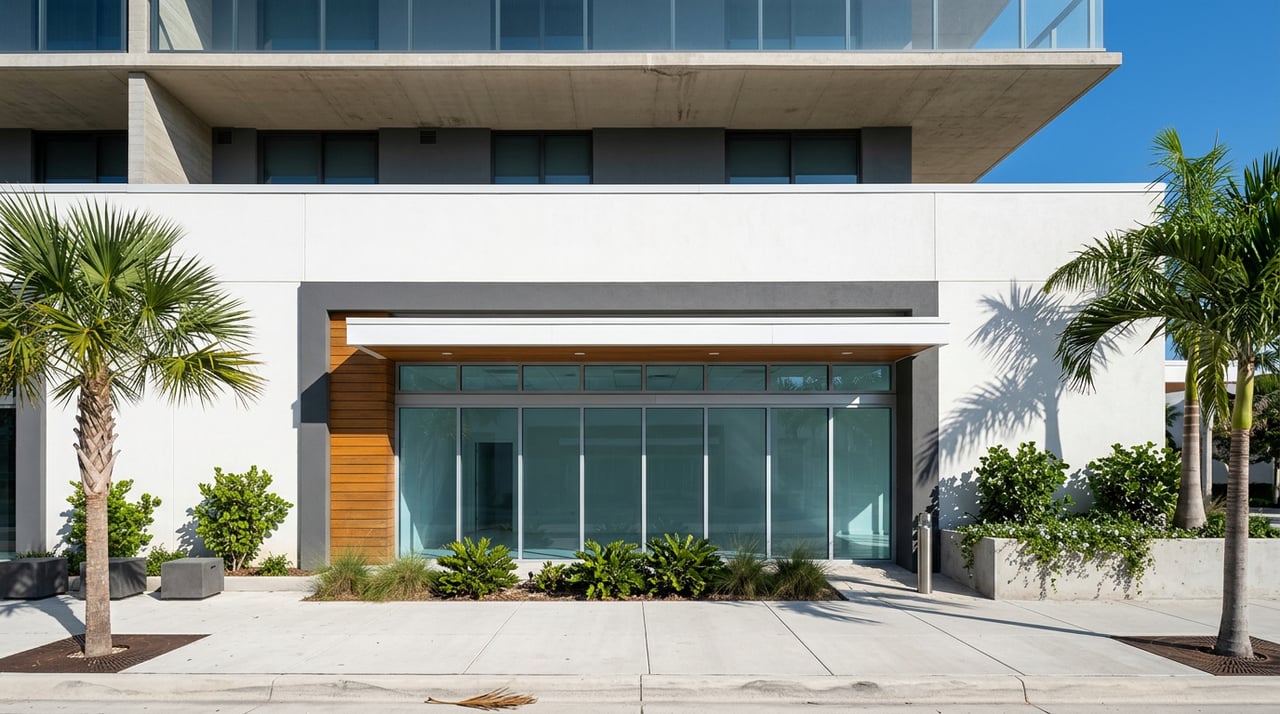
In late June 2026, a national açaí chain filed plans with the City of Tampa to convert a vacant ground-floor bay at the Inscription apartment community into an 1,135 square foot Playa Bowls with seating for 14. The address, 1244 E. Madison St., sits across from Madison Street Park, one block from Water Street, and inside what any broker will describe as one of downtown Tampa's densest concentrations of residents, workers, and visitors. On paper, that is a trophy location. In practice, the space had been vacant, the tenant is a franchised quick-service concept, and the buildout is a straight interior renovation. Nothing about the deal reads like a landlord pushing rents in a hot corridor.
That gap between the address and the deal is the whole story.
The thesis
Ground-floor retail in Channel District's residential podiums is no longer being leased as a standalone income stream. It is being leased as an absorption tool for the units upstairs, and that reprices the retail bay on the way in and on the way out. If you are underwriting one of these buildings, or a retail condo carved out of one, the last two years of comps will overstate what the bay is worth.
What the Inscription deal actually signals
Playa Bowls is a good tenant. It is also a small-format, low-buildout, quick-service concept taking a sub-1,200 square foot bay in a building where the average one-bedroom leases well north of $2,000 a month. The permit filings, first reported by Tampa Bay Business & Wealth on June 26, 2026, do not identify an opening date and the company has not publicly announced the location. That is the pattern you see when a landlord fills a stubborn vacancy quickly and quietly rather than holding out for a full-service operator.
Zoom out to the rest of the district's podium stack and the tenant mix is consistent with that read. The ground floor of Grand Central at Kennedy runs Crunch Fitness, a dry cleaner, Pourhouse, Ginger Beard Coffee, and Massage Envy. SkyHouse Channelside carries District Tavern. The Sparkman Wharf food hall a few blocks south is a shipping-container assemblage of Half Moon Seafood Co., JOTORO, Jeni's, Whatever Pops, and a Columbia Café outpost at the Tampa Bay History Center. Gas Worx to the north opened with a Gold's Gym. None of these are rent-maximizing white-tablecloth deals. They are service, fitness, coffee, quick-serve, and neighborhood bar formats sized for the resident base that walks past the door.
Why the podium math changed in 2026
The residential side of the building is under pressure, and the retail bay is paying part of the bill.
Tampa's multifamily vacancy hit 10.7% in March 2026, the highest level since CoStar began tracking the metro in 2000. Average effective rent slipped to $1,768 with forecasters projecting another 1% decline through Q4 2026. Over a third of apartment complexes in the metro are running concessions, according to True North Managed's March 2026 update. The metro delivered more than 12,500 apartment units in 2024 alone and another 7,559 units are projected for 2026, expanding inventory by 4.5% against a national average of 2.6%. Downtown Tampa was called out by name as one of the hardest-hit areas.
At the same time, Tampa's overall retail vacancy remains structurally low. Matthews put general retail vacancy at 1.8% and total Tampa retail at 3.1% in its most recent snapshot, with metro asking rents around $26.93 per square foot. Cushman & Wakefield's Q1 2026 MarketBeat showed retail investment volume at $324 million, third in Florida behind Miami and Orlando.
Put those two facts next to each other and the mechanism is obvious.
When the tower above you is running concessions and losing 1% on rent, the ground-floor bay stops being a rent-maximizing asset and starts being a leasing-office amenity. The tenant that gets the deal is the one that opens fastest, activates the sidewalk, and gives the leasing agent something to point at on a tour.
That is why a Playa Bowls, a Crunch, a coffee roaster, or a nail studio gets the space instead of the full-service operator paying $40+ per square foot on Kennedy in South Tampa.
The tenant mix that is actually leasing
A rough survey of the ground floors under Channel District's residential stack, drawn from listing pages, tenant directories, and the Tampa Downtown Partnership's current business list:
| Podium building | Representative ground-floor tenants | Dominant format |
|---|---|---|
| Grand Central at Kennedy | Crunch Fitness, Ginger Beard Coffee, Pourhouse, Massage Envy, dry cleaner | Service and daily-needs |
| Inscription Channel District | Playa Bowls (permitted June 2026) | Small-format QSR |
| SkyHouse Channelside | District Tavern | Neighborhood bar |
| Gas Worx (adjacent Ybor edge) | Gold's Gym | Fitness anchor |
| Sparkman Wharf (activation, not podium) | JOTORO, Half Moon Seafood Co., Jeni's, Columbia Café | Curated food hall |
The pattern is not a Michelin-guide corridor. It is convenience retail with the occasional destination anchor, and the destination anchors, like The Pearl on Water Street, are living inside the master-planned Water Street product rather than the older podium stock. That distinction matters when you underwrite.
What this changes for how you underwrite the deal
If you are buying a Channel District podium building, buying a retail condo carved out of one, or negotiating a lease inside one, the last two years of comps are a trap. Adjustments to make now:
- Treat sub-1,500 square foot bays as the base case, not the fallback. Demising a 4,000 square foot bay into three smaller ones is often the fastest path to occupancy in this cycle.
- Discount the retail NOI. Ground-floor rents are more likely to be negotiated with free rent, TI packages, and percentage-rent structures than to hit the market's headline $26 to $30 per square foot number.
- Give credit for the residential effect. A leased, activated ground floor materially shortens residential lease-up. If you are underwriting the full building, that shows up on the multifamily side, not the retail side.
- Reprice long-vacant bays as build-to-suit opportunities. A bay that has been dark for 18 months is telling you the last landlord tried to hold out for a full-service tenant. That is not a rent problem. It is a format problem.
- Underwrite tenant credit conservatively. Franchised QSRs, independent bars, and boutique fitness are the marginal buyer of Channel District podium space right now. That is fine, but it is not the credit profile of an anchored suburban strip center at a 6.3% cap.
Where the exceptions live
Not every ground floor in the district plays by these rules. The Water Street master plan is different product. The developers are curating tenants around a 3,500-seat music venue, a new hotel, and roughly 100,000 square feet of programmed shopping and dining, and the trophy office towers upstairs are commanding some of the highest rents in the region. Ground-floor bays inside that boundary trade on the strength of the master plan and its foot traffic, not on the leasing math of the tower above them. The Pearl is a Michelin-guide-recommended oyster room in that ecosystem for a reason.
The older podium stock along Meridian, Madison, and Channelside Drive is where the mechanism above bites hardest. That is also where the mispriced deals are, on both sides of the table.
FAQ
Is the podium retail thesis a Tampa-wide phenomenon or specific to Channel District? It is sharpest in Channel District and downtown Tampa because that is where the multifamily supply concentration is highest. South Tampa neighborhood retail centers anchored by service tenants have held occupancy and pricing power through the same period.
Does a smaller tenant mix hurt exit cap rates? It changes the buyer pool. A rent roll of local service and franchised QSR tenants trades at a wider cap than a national credit anchor, but the residential absorption benefit is real and shows up in the multifamily valuation if you own the whole building.
How long does this last? Full-year 2026 multifamily absorption in Tampa Bay is forecast at 6,126 units against 7,559 deliveries, so the supply overhang persists into 2027. Construction starts have slowed sharply, which sets up a recovery window in late 2027, but the podium retail dynamic will lag the residential recovery by several quarters.
Work with a broker who reads the whole stack
Channel District ground-floor deals look like retail transactions and price like residential absorption tools. Underwriting one without pricing in the other is the fastest way to overpay right now. Alan J. Kronenberg works Tampa Bay podium retail, mixed-use, and adjacent multifamily assignments with a CCIM-level underwriting approach and a curated pipeline of off-market opportunities. If you are evaluating a Channel District bay, a full podium building, or a Water Street trophy asset, start with the Commercial Connection briefing or Let's Connect directly.