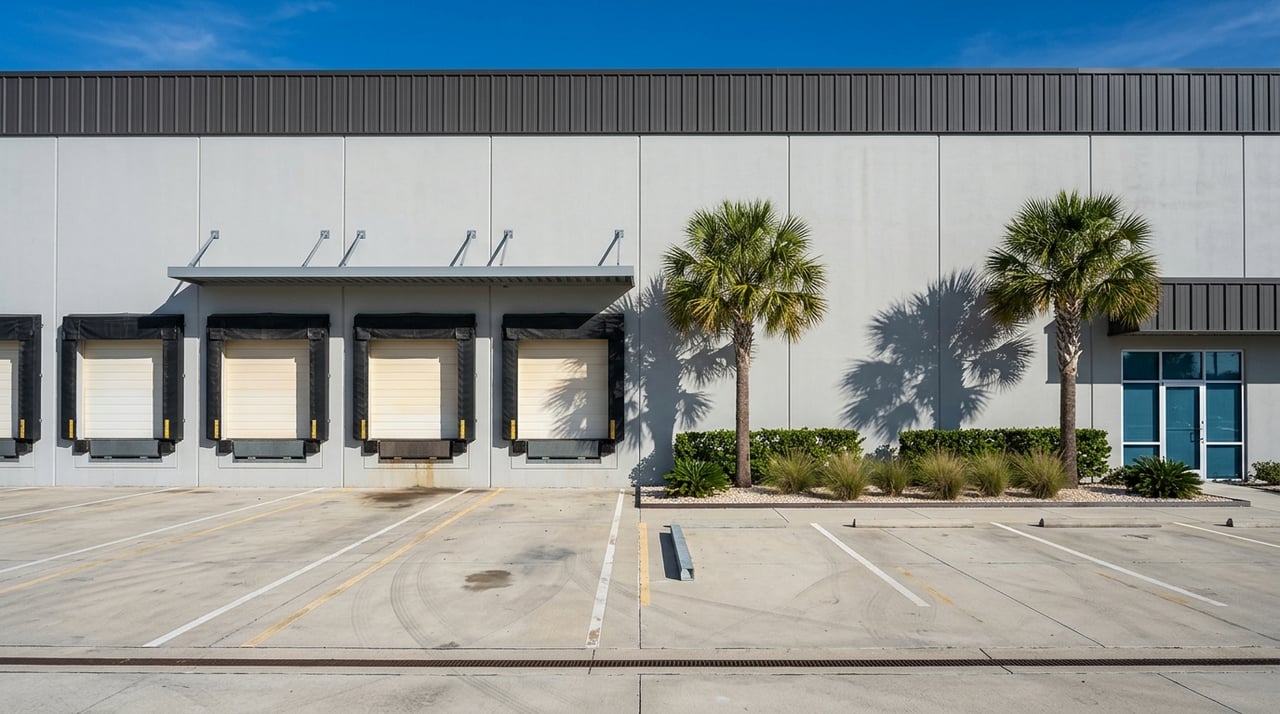
If your fleet needs a Tampa location, the cheapest option is not always the smartest one. What matters is how your site supports daily dispatch, driver routes, vehicle access, and occupancy costs over time. If you are comparing Drew Park with other Tampa industrial hubs, this guide will help you understand where Drew Park fits, what premium you are paying for, and when another submarket may serve you better. Let’s dive in.
Drew Park’s role for fleet users
Drew Park is an airport-adjacent infill district on Tampa’s west side with a mixed-use layout and a light-industrial core. The City of Tampa notes that it remains one of the few remaining Tampa locations with affordable industrial land and space, even though it is also a premium infill location compared with other industrial hubs. That combination makes it unusual in the local market.
For fleet users, Drew Park is best viewed as a convenience-driven operating node rather than a big-box warehouse district. The available product tends to be older, smaller-bay industrial space built for flexibility and proximity, not modern high-clear distribution use. In practical terms, you are often choosing Drew Park for location efficiency first.
Why Drew Park stands out
Airport proximity helps daily operations
Drew Park benefits from its position near Tampa International Airport, which sits five miles west of downtown Tampa and is accessed from I-275, Highway 60, and the Veterans Expressway. That access pattern makes the area especially useful if your operation depends on quick trips into west Tampa, downtown, or airport-related corridors.
If your drivers are making repeated short runs instead of long regional hauls, that location can matter more than building specs alone. Service fleets, airport-facing users, and regional dispatch teams often value minutes saved on every route. In that setting, Drew Park can outperform lower-rent alternatives.
Small-bay space fits certain fleet models
A current Drew Park lease example shows the type of product common in the area: a 1986-built small-bay warehouse in the Westshore/Airport submarket with 13-foot-10-inch to 16-foot-2-inch clear height and one grade-level door per unit. That is a very different profile from newer Class A logistics space.
For many fleet users, that can still work well. If you need staging space, vehicle parking support, light storage, tools, or local dispatch space, small-bay product may be more practical than a large regional warehouse. The tradeoff is that you are typically not getting the dock-heavy design and modern trailer circulation found in newer projects.
Drew Park vs East Tampa
East Tampa is the highway-first option
If Drew Park is about proximity and convenience, East Tampa is more about highway reach and modern logistics function. A 2026 East Tampa project reports immediate access to I-4 and I-75, with about 20 minutes to downtown Tampa, 25 minutes to Tampa International Airport, and 7 minutes to I-75.
That makes East Tampa a cleaner fit for operators moving across the broader region. If your routes depend on interstate access, tractor-trailer movement, or regional distribution, East Tampa may offer a better functional setup than Drew Park.
Building features favor heavier truck use
The difference in building design is just as important as the map. East Tampa’s newer product includes features such as 32-foot clear heights, 190-foot truck courts, 13 to 32 dock-high doors depending on the building, trailer parking, and ESFR systems.
Compared with Drew Park’s older small-bay stock, East Tampa is built for a different operating model. If your fleet needs docks, trailer storage, and large vehicle maneuvering, East Tampa is likely the stronger operational match.
Rent is not the only comparison
CBRE’s Q1 2026 Tampa industrial report shows East Tampa at $11.54 per square foot NNN. The Airport submarket, which is the best benchmark for Drew Park, sits at $13.52 per square foot NNN.
That means Drew Park carries a notable rent premium over East Tampa. Still, if your business gains enough route efficiency from being closer to west Tampa, downtown, or the airport, the higher rent may be justified. The right answer depends on your daily operating pattern, not just the quoted lease rate.
Drew Park vs Port Tampa Bay and Causeway
Port users need a different hub
Port Tampa Bay is Florida’s largest and most diverse port, and it serves a very different kind of industrial demand. The port highlights direct interstate access, a dedicated truck ramp to the Selmon Expressway about one mile from the gate, a 100-acre container terminal, a new gate complex, six post-Panamax cranes, more than 7,000 feet of berth, and a 43-foot channel depth planned to deepen to 47 feet.
If your operation is tied to cargo flow, import and export activity, or drayage, Drew Park is not the natural comparison winner. In that case, the port area is designed around freight movement in a way Drew Park is not.
Modern cargo facilities change the equation
A 2026 Class A project near the Causeway, less than 3 miles from the port entrance, offers 36-foot clear height, 24 dock-high doors, 2 ramps, and 51 trailer spaces. That kind of facility supports a much more cargo-intensive model than a typical Drew Park building.
For fleet users, the question is simple: are you dispatching service vehicles or supporting port-connected freight? If you are focused on local service coverage, Drew Park may still be the better fit. If container flow and heavy truck circulation drive your business, the port area likely has the advantage.
Drew Park vs Plant City and Pasco
Expansion users often look farther out
Plant City and Pasco are better known as outboard expansion corridors. CBRE reports that much of the active construction pipeline is concentrated there because of cheaper land, making those areas the more obvious lower-cost big-box alternatives to Drew Park.
That matters if your fleet operation is growing and needs scale more than centrality. For users who can trade infill convenience for larger footprints, these submarkets often deserve serious attention.
Lower rent can support scale
The same CBRE report shows Plant City at $7.82 per square foot NNN and Pasco County at $11.32 per square foot NNN. By comparison, the Airport submarket is $13.52 per square foot NNN.
Plant City in particular shows how large the pricing gap can be. Drew Park’s Airport benchmark is about 72.9% higher than Plant City, which makes the infill premium very real for budget planning. If your operation can perform well from a farther-out location, those savings may support more space or future expansion.
What fleet users are really paying for in Drew Park
This is a location premium market
Drew Park is not the cheapest submarket, and it is not where the newest fleet buildings are being delivered. It is a scarcity-driven convenience market where location does much of the value work.
That premium shows up clearly in market data. CBRE reports an average direct asking rent of $10.95 per square foot NNN across the Tampa industrial market, while the Airport submarket is higher at $13.52 per square foot NNN. Since these are net rents, taxes, insurance, and major maintenance are added on top of the quoted rate.
Small space often costs more per foot
There is also a strong size premium in Tampa industrial leasing. CBRE reports that spaces under 100,000 square feet average $12.23 per square foot NNN, while spaces from 500,000 to 749,999 square feet average $7.06 per square foot NNN.
That spread helps explain why fleet users looking for smaller infill space can feel sticker shock. In many cases, you are paying more per square foot not because the building is newer, but because smaller, well-located space is limited and operationally useful.
When Drew Park makes sense
Drew Park is often the right choice when your operation depends on quick access to the airport, west Tampa, and downtown. It also works when your fleet model fits small-bay industrial space and your team values short local runs over interstate-heavy distribution.
You may want Drew Park on your short list if you need:
- Airport-adjacent access
- Fast reach to west Tampa and downtown
- Small-bay warehouse functionality
- Local dispatch efficiency
- Infill positioning over big-box scale
In those cases, the higher occupancy cost may be a smart trade for better daily performance.
When another Tampa hub may fit better
Drew Park is not the best answer for every fleet user. If your operation needs modern docks, heavy trailer parking, large truck courts, or lower-cost expansion space, another submarket may align better with your business model.
Here is a simple way to think about the comparison:
| Submarket | Best Fit for Fleet Users | Key Tradeoff |
|---|---|---|
| Drew Park / Airport | Airport-facing fleets, local service dispatch, west Tampa and downtown coverage | Higher rent, older small-bay stock |
| East Tampa | Highway access, regional routes, modern logistics layouts | Less west Tampa convenience |
| Port Tampa Bay / Causeway | Cargo flow, drayage, port-connected operations | Built for freight-heavy use, not every local fleet |
| Plant City / Pasco | Lower-cost scale and big-box growth | Farther from Tampa’s urban core |
How to evaluate your next fleet location
Before you choose a submarket, focus on how your operation actually functions day to day. The best lease is not just the lowest rate. It is the one that supports route efficiency, vehicle movement, labor access, and growth without creating hidden costs.
A useful review should include:
- Trip patterns to customers, vendors, and service areas
- Access to I-275, I-4, I-75, Highway 60, or the Veterans Expressway based on your routes
- Whether you need grade-level loading or dock-high loading
- Required trailer or vehicle parking
- Clear height and maneuvering needs
- Total occupancy cost under an NNN lease structure
- Whether you need infill convenience or expansion capacity
That kind of analysis is where site selection becomes more than a map search. It helps you compare Drew Park and other Tampa hubs based on operating reality.
If you are weighing Drew Park against East Tampa, the port area, Plant City, or Pasco, a market-specific review can save you from picking a location that looks good on paper but underperforms in practice. For tailored guidance on industrial site selection, lease negotiation, or acquisition strategy in Tampa Bay, connect with Alan J. Kronenberg.
FAQs
Is Drew Park a good Tampa location for service fleets?
- Yes. Drew Park is especially strong for airport-facing users, service fleets, and regional dispatch operations that value short trips to west Tampa and downtown.
Why is Drew Park industrial space more expensive than some other Tampa submarkets?
- Drew Park is best benchmarked to the Airport submarket, which CBRE reports at $13.52 per square foot NNN, higher than the Tampa market average and well above Plant City. The premium reflects airport-adjacent infill location and limited small-space availability.
How does Drew Park differ from East Tampa for fleet operations?
- Drew Park is generally better for local convenience and airport access, while East Tampa is better for interstate reach, larger truck movement, and modern dock-heavy buildings.
Is Drew Park the best choice for port-related trucking in Tampa?
- Not usually. Port Tampa Bay and the Causeway area are the more natural fit for cargo-intensive, import/export, and drayage-focused operations.
What kind of industrial buildings are common in Drew Park?
- Drew Park often features older small-bay industrial product. A current example in the Westshore/Airport submarket shows 1986 construction, 13-foot-10-inch to 16-foot-2-inch clear height, and one grade-level door per unit.
Should a growing fleet look at Plant City or Pasco instead of Drew Park?
- It may make sense if your priority is lower-cost scale or big-box growth. Plant City and Pasco are outboard expansion corridors with more land availability than airport-adjacent infill areas like Drew Park.